



Charing Cross Hospital is early adopter of innovative implant treatment for sleep apnoea
Imperial College Healthcare is one of a very small number of NHS Trusts to start offering a pioneering surgical implant as a treatment for moderate to severe sleep apnoea, in cases where traditional treatments haven’t worked. Sleep apnoea is a condition when someone’s breathing stops and starts while they sleep - and can lead to serious problems, if left untreated.
Hypoglossal nerve stimulation (HGNS) uses an innovative device, about the size of a pacemaker or two 50p pieces side-by-side, which is implanted into the chest. Once activated, it can sense when someone stops breathing in their sleep and stimulate a nerve in the tongue to stop it blocking their airway.
Imperial College Healthcare believes that there are just eight other NHS Trusts in England offering this treatment. The first patients received their implant under general anaesthetic this month at Charing Cross Hospital and went home the next day following overnight monitoring. They will return in around four weeks for the device to be activated.
Sleep apnoea
Sleep apnoea is a condition where a person’s airway becomes blocked during sleep and leads to interrupted breathing. This can cause tiredness, problems concentrating, mood swings and headaches. Without treatment, it can lead to more serious problems including high blood pressure, type two diabetes and heart disease.
The condition can sometimes be treated by making lifestyle changes, such as losing weight, giving up smoking and reducing how much alcohol you drink. But many people need to use a Continuous Positive Airway Pressure (CPAP) machine, which gently pumps air into a mask while they sleep.
CPAP will work for most patients with moderate or severe sleep apnoea. But if it doesn't, they may be able to access HGNS at a small number of NHS hospitals in the UK. Guy’s and St Thomas’ became the first Trust in England to treat a patient with this implant in 2023, following many thousands of procedures worldwide.
How HGNS works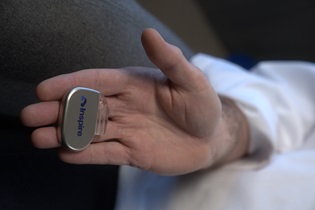
Introducing HGNS at Imperial College Healthcare will increase the options available to clinicians supporting patients within the Trust’s sleep service. The procedure involves a sensor being implanted into the chest wall muscles of a patient, where it can identify instances where they stop breathing. The device, from Inspire Medical Systems Europe, has a small wire which connects to the hypoglossal nerve in the neck that controls tongue muscles. All the patient needs to do each night is to switch on the device with a remote control when they’re ready to sleep.
Aphrodite Iacovidou, ENT airway and laryngology consultant at Imperial College NHS Healthcare Trust, led the implant procedures at Charing Cross Hospital. She said: “I’m delighted that we’re able to offer this innovative treatment to our patients, in those rare cases where traditional options aren’t working.
“Sleep is so important for our ability to go about our day-to-day lives and stay healthy, so we want to do all we can to help our patients. I'm so grateful to my colleagues across our sleep and ENT services for coming together and making it possible for us to offer this option.
“It is however important to emphasise that this involves a surgical procedure and won’t be suitable for most patients, who do respond to traditional treatments such as CPAP and lifestyle changes.”
Dr Gillian Twigg is a consultant clinical scientist and sub-speciality lead for sleep at Imperial College Healthcare NHS Trust, who oversees the activation of HGNS and ongoing support for patients. She said: “This is a significant moment for our sleep services, with our first patients starting their HGNS journey.
“We will be activating their devices in around four weeks, after they’ve had time to recover from the procedure. Sleep apnoea can have a huge impact on your everyday life and long-term health, so I'm really looking forward to seeing the difference this should make to each of our patients.”
Find out more about sleep apnoea and support.


